All resources

Delia Rowland
Blog
.png)
Gen Z is already on your buying committee — and they're researching vendors in AI, not Google. Here's what that means for your brand visibility strategy in 2026.
TL;DR: Two-thirds of 18-24 year olds now use ChatGPT to find information nearly as often as Google. That matters for B2B because Gen Z is already on buying committees, and half of B2B software buyers now start their vendor research in an AI chatbot. But Google rankings don't translate to AI visibility: 80% of URLs cited by LLMs don't even rank in Google's top 100. If your brand isn't being mentioned in the sources AI tools cite, you're invisible to the people actually building the shortlist. The good news: brands that invest in AI visibility are seeing measurable results: higher conversion rates, faster pipeline, and real revenue impact.
In this post:
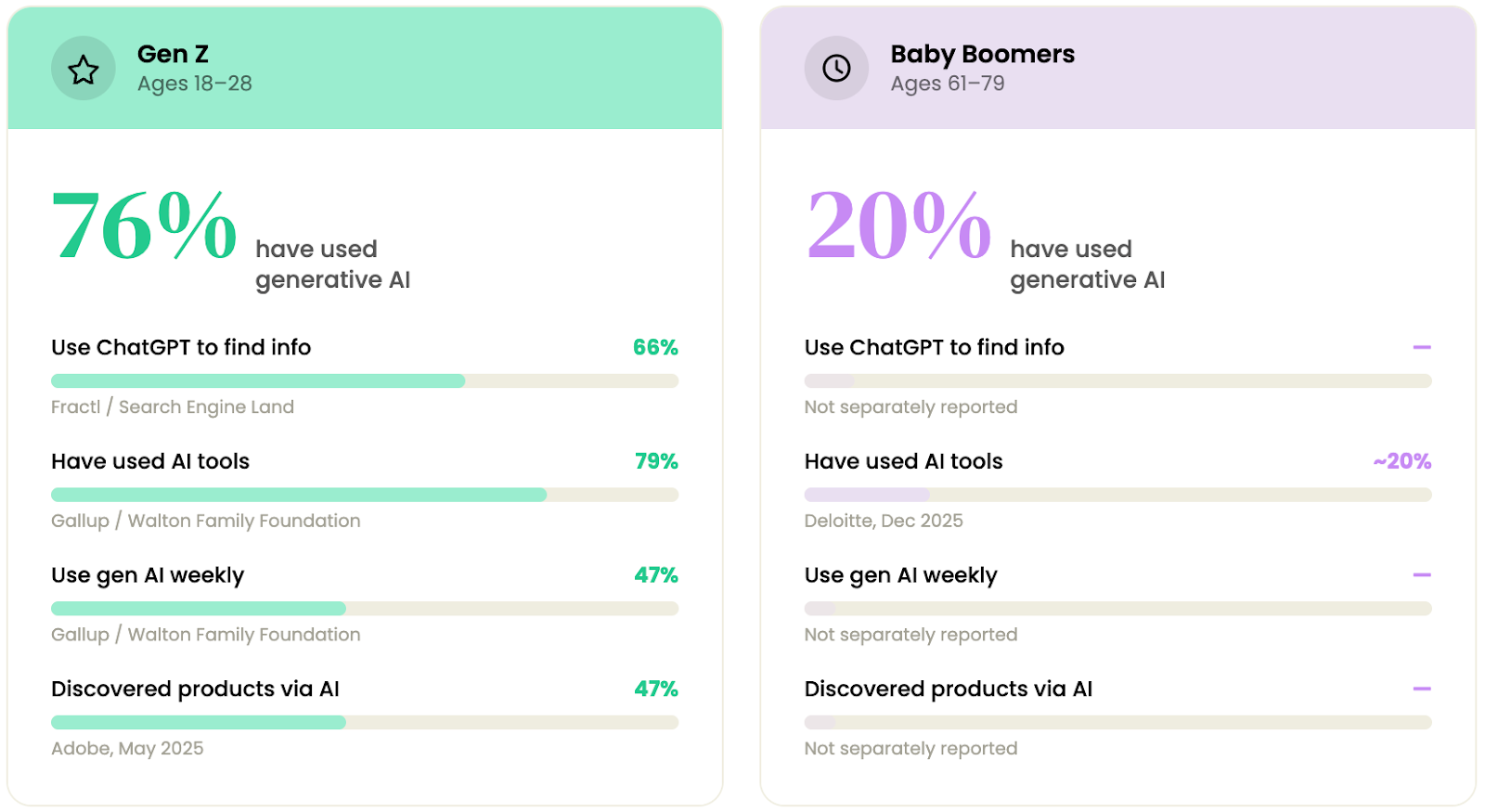
A Fractl/Search Engine Land study surveying over 2,000 consumers found that 66% of 18-24 year olds use ChatGPT to find information. Google? 69%. That gap is nearly closed and for the youngest cohort of working professionals, AI search is already a near-default.
This isn't a fringe habit. Adobe surveyed 1,000 U.S. respondents in May 2025 and found that among ChatGPT users, 28% of Gen Z start their searches directly in ChatGPT — more than any other generation — and 47% of Gen Z have discovered new products or services through AI tools.
The Gallup/Walton Family Foundation survey (n=3,465 respondents aged 13-28) found that 79% of Gen Z have used AI tools, and 47% use generative AI weekly with the same cohort consistently preferring AI tools that give direct answers over traditional web search.
Compare that to older generations. Deloitte's December 2025 report found that 76% of Gen Z had used a generative AI tool by mid-2025. For Boomers, it’s just 20%... This is a fundamentally different way of finding information, split cleanly along generational lines.
And the pipeline of AI-native searchers is only growing. Pew Research Center's February 2026 study surveyed 1,458 U.S. teens (ages 13-17) and found that 64% have used AI chatbots, 57% use them specifically to search for information, and nearly 3 in 10 use them daily.
Those Gen Alphas are the interns of today and the buyers of tomorrow.
Their habits aren't going to soften as they enter the workforce — they're going to compound.
It's easy to read the stats above and file them under "consumer behavior." Gen Z is Googling less for restaurants. Cool. But that's not the story that should keep B2B marketers up at night.
Gen Z is also researching vendors in ChatGPT. And they're not the future buyer — the oldest Gen Z-ers are 28. They're product managers, marketing directors, RevOps leads. They're already on buying committees.
The data backs this up. G2 surveyed over 1,000 B2B software buyers in August 2025 and found that 50% now start their purchasing journey in an AI chatbot instead of Google — a 71% jump from just four months prior. Among those using AI for vendor research, 74% prefer ChatGPT. A separate study from Responsive found that 1 in 4 B2B buyers use generative AI more than conventional search engines, and among tech buyers specifically, 56% now use chatbots as a top source for vendor discovery.
Think about what that means for your funnel.
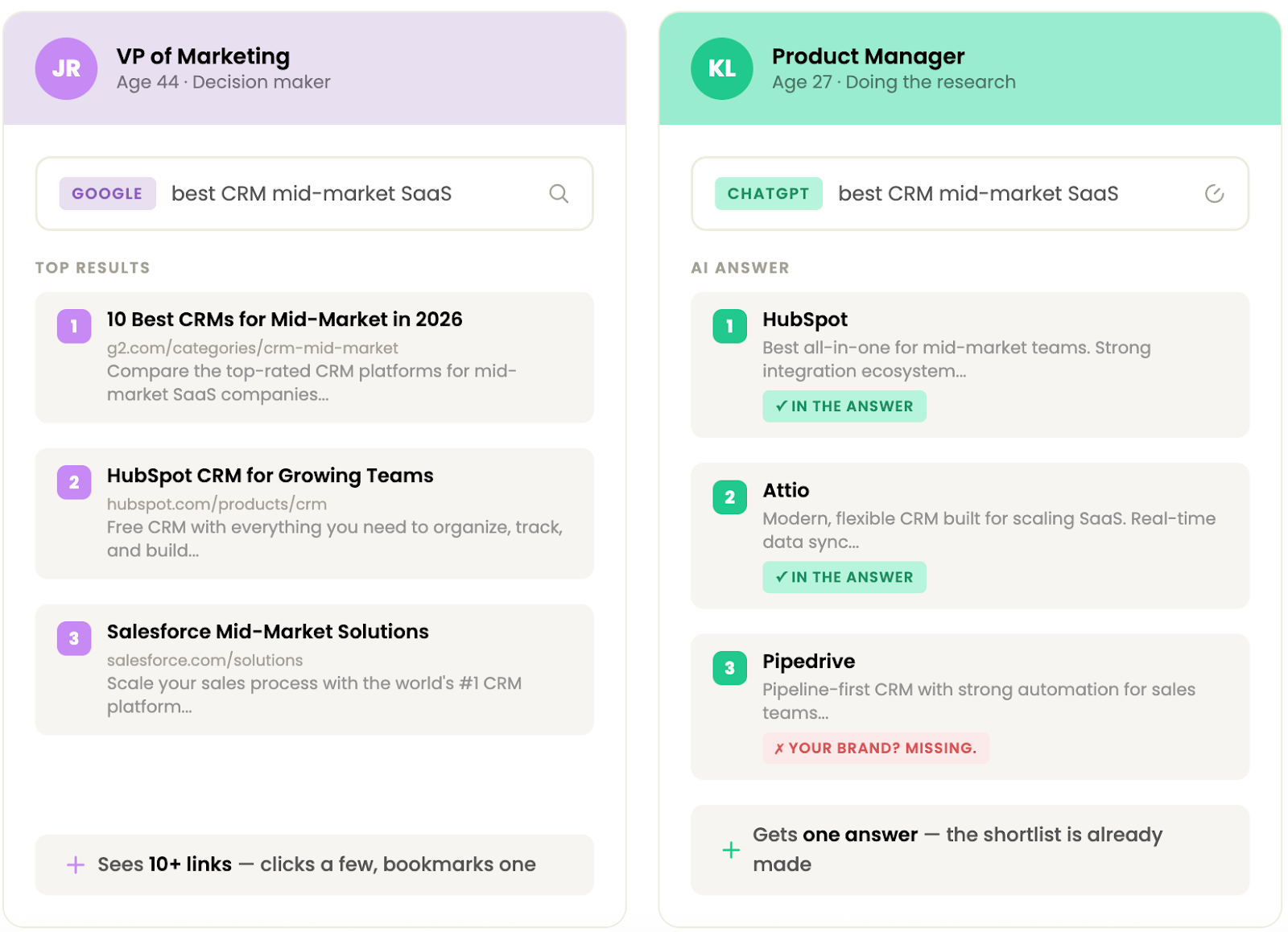
Your VP of Marketing might still Google "best CRM for mid-market SaaS." But the 27-year-old PM who's actually doing the research is asking ChatGPT the same question. If your brand doesn't come back in that answer, you never make her shortlist — and the VP never hears your name.
This isn't something that might happen in 2028. eMarketer reported in October 2025 that 55% of Gen Z buyers already find AI helpful for evaluating vendors, which is up from 37% just one year earlier.
The market can feel how fast this is moving. G2 reported that the AEO software category on their platform grew from 7 products to over 150 between March 2025 and January 2026 — more than 2,000% growth. When an entirely new software category explodes that fast, it's because the underlying behavior shift is real and urgent.
If your instinct right now is "we're already investing in SEO, we'll be fine," this is the section that should give you pause.
Ahrefs analyzed citations across ChatGPT, Gemini, Copilot, and Perplexity and found that 80% of URLs cited by LLMs don't even rank in Google's top 100 for the original query. Only 12% of LLM-cited URLs appear in Google's top 10. Being the #1 result on Google doesn't mean you're anywhere in the AI answer because LLMs aren't reading the SERP. They're synthesizing from a completely different source set.
So what are they reading? Third-party content.
AirOps' 2026 State of AI Search report found that 85% of brand mentions in AI search come from third-party pages, not your own domain. The listicles, comparison guides, review sites, and forum threads that mention your brand matter more for AI visibility than your own blog. And brands that earn both a mention and a citation are 40% more likely to resurface across consecutive AI answers.
The data from SE Ranking's study of 129,000 domains reinforces this from a different angle.
Domains with millions of brand mentions on Reddit and Quora have roughly 4x higher citation rates in ChatGPT than those with minimal community presence. Sites with profiles on review platforms like G2, Capterra, and Trustpilot are 3x more likely to be cited. And domains with 32,000+ referring domains are 3.5x more likely to show up as a source.
This is just the tip of the iceberg. We have 25 more stats every marketer should know about the rise of AEO here.
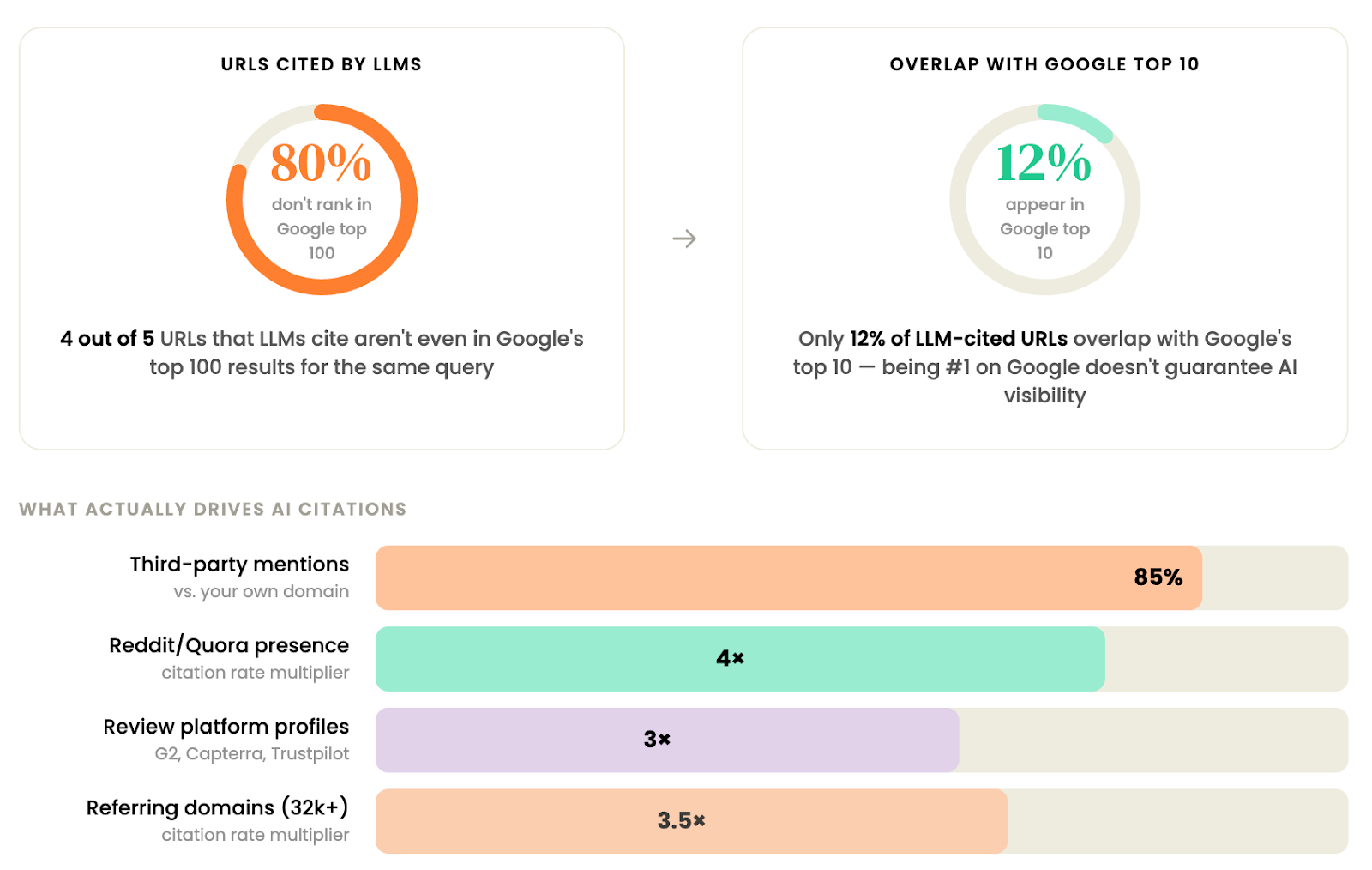
The point is that ranking on your own domain is necessary but no longer sufficient. Your brand needs to exist in the sources these models trust: the roundups, the listicles, the comparison articles, the community discussions.
If you're only investing in on-site SEO, you have a major blind spot.
We saw this play out directly in Noble's work with Graphite. With just 6 strategically placed mentions in third-party articles that LLMs actually cite, Graphite went from 0% to 33% share of answers in the "best SEO agencies" cluster and saw a 4.5x increase in overall AI share of voice. The mentions weren't random. They were placed in the specific sources the models were already reading.
The most common pushback on AI search is that it's too early to invest. Traffic is small. ROI is unproven. Wait and see.
Here's the problem with "wait and see": the companies that are investing are already seeing returns that traditional SEO can't match.
The brands treating AI search as a real channel — investing in third-party mentions, tracking citations, optimizing for the sources LLMs read — are pulling ahead.
The ones waiting for more data are becoming the data.
If you want some more insight on the top 10 common pitfalls we see in AI search, we write about it in depth here.
Your next buyer is already asking ChatGPT for recommendations. The question isn't whether AI search matters; it's whether your brand is in the answer.
Talk to Noble to find out where you stand.
About Noble: Noble is an AI search platform that automates the outreach, negotiation, and payment required to get your brand mentioned in the sources LLMs cite. The result: you show up in AI-generated answers. Book a demo here.
GET DISCOVERED ON