All resources

Delia Rowland
Blog
.png)
The research on why brand mentions drive AI visibility, the campaign results that prove it, and what it means for your marketing budget.
TL;DR: Answer engine optimization (AEO) is the practice of getting your brand cited in AI-generated answers, not just ranked in traditional search. The research is clear: brand mentions across the web are the strongest predictor of AI visibility, outperforming backlinks by 3x. Across four Noble campaigns spanning different industries and volumes, targeted placement in the sources LLMs cite produced AI visibility lifts ranging from 33% to 313%. AEO isn't theoretical anymore. The data is in.
In this post
AEO (answer engine optimization) is the practice of getting your brand cited in the answers that AI platforms generate. When someone asks ChatGPT, Perplexity, or Google AI Overviews a question about your category, AEO determines whether your brand shows up in the response.
It's different from traditional SEO in one important way. SEO is about getting your page to rank. AEO is about getting your brand mentioned in the sources that AI models pull from when they build an answer. The unit of visibility shifts from your URL to your brand's presence across the web.
This isn't a replacement for SEO. Most of the fundamentals still apply. AEO is one additional layer — and the shift is already well underway. ChatGPT now has over 900 million weekly active users. Roughly 1.25 trillion Google searches now trigger an AI Overview. And according to Wynter's 2026 CMO survey, 84% of B2B SaaS CMOs now use AI tools for vendor discovery — up from 24% just a year ago.
Your buyers are already searching this way. The question is whether your brand shows up when they do. Two bodies of evidence say AEO works: large-scale research and real campaign results.
Ahrefs analyzed 75,000 brands to find which factors most strongly correlate with visibility across ChatGPT, Google AI Mode, and AI Overviews. The strongest factor wasn't domain authority. It wasn't backlinks. It was how often your brand is mentioned across other websites.
The numbers make the hierarchy clear:
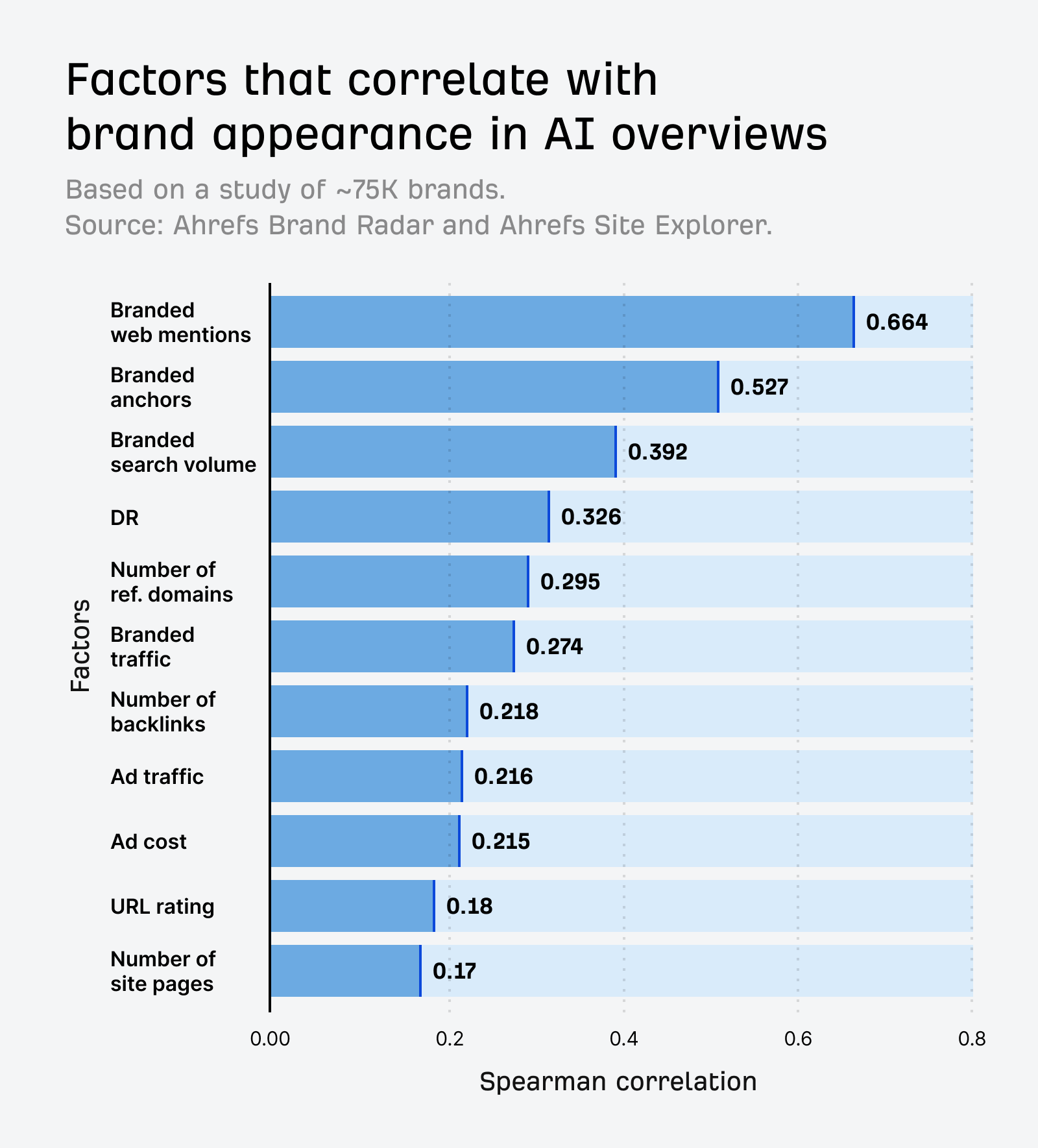
Brand web mentions correlate 3x more strongly with AI visibility than backlinks do. And the volume of content on your own site barely registers. Publishing more blog posts on your domain, by itself, does very little for your AI presence.
This matters because of where LLMs actually pull their answers from. According to AirOps research, roughly 85% of LLM citations for category queries come from third-party sources — not your own website. Brands are 6.5x more likely to be cited through someone else's page than through their own domain. Your on-site content matters, but the game is won off-site.
There's also a cliff effect. Brands in the top 25% for web mentions earn 10x more AI Overview appearances than brands in the next quartile down. This isn't a gradual curve where a few more mentions get you a few more appearances. There's a threshold, and if you're below it, you're largely invisible to AI regardless of how strong your on-site SEO is.
The implication: if you've been investing exclusively in your own content and your own domain, you have a blind spot. Your site matters for long-tail queries and technical depth. But for the category-level questions that drive buying decisions, the answer is built from sources you don't own.
That raises the obvious follow-up: if brand mentions are the lever, what happens when you go out and actually get them?
Most AEO content stops at the correlation data. Mentions matter, got it, but does deliberately placing your brand in LLM-cited sources actually move the needle?
We've published the results from four campaigns across different industries and volumes. Each one targeted the same dynamic: identify the third-party articles that AI models cite for a given category, then get the client mentioned in those specific sources.
Here's what happened:
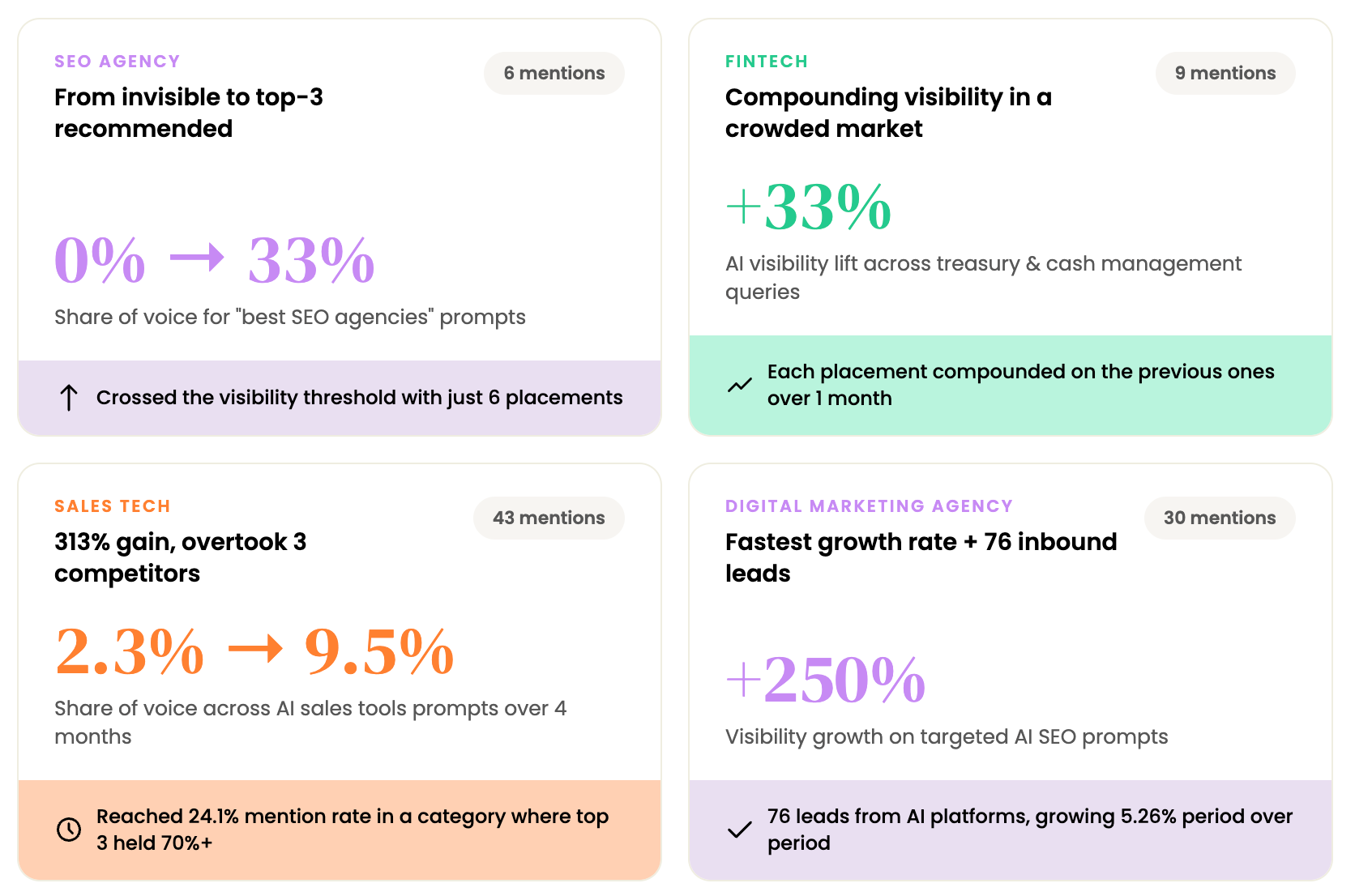
Avenue Z saw 250% visibility growth on targeted AI SEO prompts, climbing from roughly 2% to 7% over the course of 30 mentions going live. That was the fastest growth rate of any tracked agency in a category where every competitor was actively optimizing. They achieved the largest position improvement of any tracked competitor by more than 3x, rising to #4 among top agencies.
The agency has tracked that AI-sourced contacts growing 5.26% period over period. This is where AI visibility connects directly to pipeline.
A leading fintech company had strong brand recognition but low AI visibility for treasury and cash management queries. With 9 targeted placements over a one-month pilot, AI visibility rose 33% across the tracked prompt cluster. The lift wasn't a single spike, either. Each placement built on the previous ones, compounding over time.
One of the largest names in sales tech sat at just 2.3% share of voice across AI sales tools prompts despite having a dominant market position. Over a four-month campaign with 43 targeted mentions, share of voice jumped to 9.5% — a 313% increase. The brand overtook three direct competitors in the process, reaching a 24.1% average mention rate.
In a category where the top three incumbents held 70%+ of AI visibility, sustained coverage created enough surface area to break through.
Different industries, different campaign sizes, different starting points, same upward trend. Targeted placement in the sources LLMs already cite produced measurable, compounding visibility gains.
Additional pilots are in progress and we'll be sharing more data as they complete.
If you're evaluating AEO, you've probably heard some version of these (we certainly have). They are fair points, but here's what the data actually tells us.
That number is real: a 13-month study from Search Engine Land found that LLM referral traffic accounts for less than 2% of total referral traffic on average. But that same study found something else: LLM referrals convert at roughly 18%, making them the highest-converting traffic source in the dataset — higher than paid shopping, SEO, or PPC.
The volume may be small (although we’d argue traffic is much higher than 2%), but it’s undeniable that the quality is exceptional. And the growth rate is steep: LLM referral traffic grew 80% half-over-half in 2025, with some companies seeing 300% increases.
A lot of them don't, but that's the wrong thing to measure. When someone sees your brand recommended by ChatGPT, many of them open a new tab and Google your brand name directly. Around 93% of AI Mode sessions end without an external click — meaning for a growing share of searches, the AI answer is the result.
A case study from Graphite actually measures this. When workflow automation platform n8n compared GA4 last-touch data to post-conversion survey data, GA4 attributed 1% of conversions to AEO, and the survey showed 9%. So last-touch analytics is missing roughly 90% of what AEO is actually driving.
The same study also found AEO is converting 33% better than organic search at n8n, and LLM-attributed conversions are roughly doubling month over month.
The value nowadays is in being named when the buying question gets asked. Your brand becomes top of mind at the exact moment someone is evaluating options, even if they don't convert in that session.
Ranking and being mentioned are different things. You can hold position #1 for a keyword and still be absent from the AI-generated answer for that same query.
The behavioral shift is real, too. Wynter's 2026 survey found that 68% of B2B SaaS CMOs now start their vendor searches with AI tools before traditional search engines. Google still plays a role, but it's increasingly a verification step, not a discovery step. If your brand isn't in the AI answer, strong Google rankings don't get you back into the conversation.
Everything above is based on data we can see right now, but every signal points in the same direction. AI Overviews already appear in roughly half of Google searches, and that number has been climbing steadily. Google's AI Mode — a fully conversational search experience with no traditional blue links — has crossed 100 million users and is widely expected to become the default search experience.
If that happens, every Google search becomes an AI answer. The brands that show up in those answers will be the ones that invested in being mentioned across the sources LLMs trust. The ones that waited will be starting from zero.
If you're already running SEO, AEO doesn't require tearing anything up. It's one new motion: identify the sources that AI models cite for your category, check whether you're mentioned in them, and get placed where you're not.
The problem is that traditional SEO vendors aren't built for offsite placement because it requires an entirely different set of relationships and workflow.
You can run this process manually. Query your buyers' questions in ChatGPT, Perplexity, and Google AI Overviews. Look at the sources in the answers. Cross-reference against your current mentions. The gaps become your to-do list.
The hard part is doing this at scale. Each mention involves identifying the right article, reaching the right author or publisher, negotiating a placement, and managing the payment. That's where Noble comes in. We automate the outreach, negotiation, and payment so your brand gets placed in the sources that power AI answers. No need to manage 20+ manual steps per mention or negotiate with publishers yourself.
Want to know more about our outreach process? We have a blog on that too.
About Noble: Noble is an AI search platform that automates the outreach, negotiation, and payment required to get your brand mentioned in the sources LLMs cite. The result: you show up in AI-generated answers. See pricing or get started.
GET DISCOVERED ON